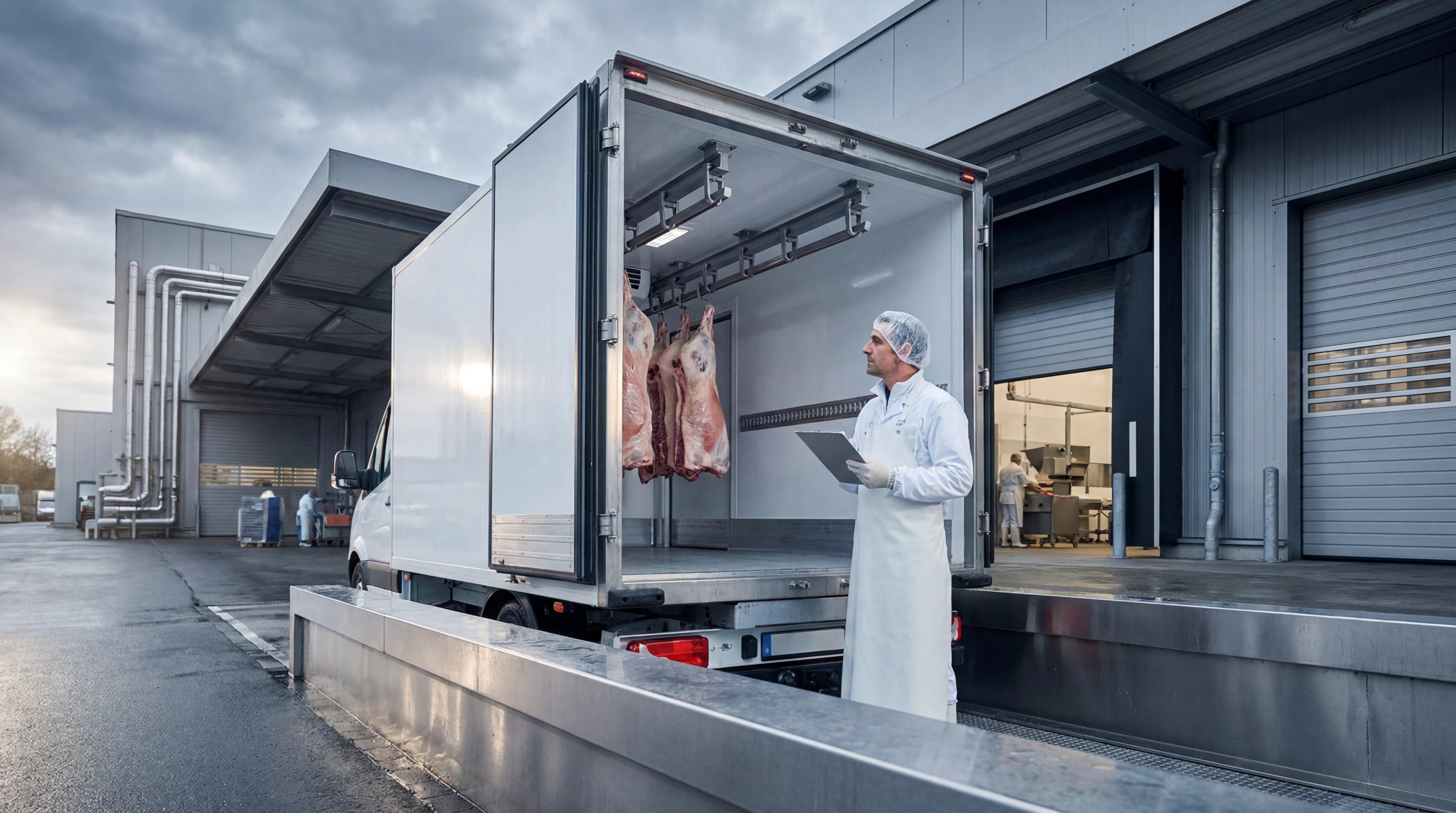
Meat: temperature under control. Process under control.
Refrigerated vehicles for meat transport must do more than cool. Hygiene, robustness and a seamless cold chain are mandatory. We deliver exactly that.
Value proposition
What meat logistics teams find at TBV
Temperature-compliant per 853/2004
Fresh meat below 7 degrees, minced meat below 2 degrees, poultry below 4 degrees, offal below 3 degrees. Pinpoint accurate, even in multi-zone operation.
Hanging, lying or combined
V2A rail systems per DIN 17455 with Euro hooks and double-deck function. One body for half carcasses, boxed goods and vacuum pallets.
Audit-ready per IFS Logistics
Stainless steel interior walls, seamless floor transitions, documented cleaning and disinfection cycle in 30 to 45 minutes between tours.
Concept
Meat is the premier discipline of the cold chain
Between slaughterhouse, cutting plant and fresh counter, every degree and every hour decides on shelf life, drip loss and microbiological safety. TBV builds bodies that mirror this reality: V2A rail systems for hanging halves and quarters, exchangeable floor cassettes for converting from hanging to lying, separate cooling zones for minced meat and offal in the same vehicle. We think vehicle, hygiene and route profile together. The result: a body that convinces the IFS Logistics auditor just as much as the driver on shift change.
HACCP and interior configuration in detail
HACCP does not start in the cold store, it starts at the ramp. The critical control points in the transport of meat of animal origin under Regulation (EC) 853/2004 are temperature control, cargo-area hygiene and protection against cross-contamination. Our bodies implement this structurally: V2A stainless surfaces 1.4301 for all meat-contact components, closed hollow-section profiles, raised coving at the floor transition, tight door seals and refrigerant circuits with low GWP. Multi-zone bodies receive a longitudinally movable partition with its own evaporator, so that minced meat below 2 degrees can run in parallel with poultry below 4 degrees and frozen goods below minus 18 degrees.
Hanging transport on rails protects the product mechanically, reduces pressure points and accelerates re-cooling after crust freezing or rapid chilling at the slaughterhouse. Where flexible tours with boxed and vacuum goods are required, rails can be modularly unhooked and the floor converted for pallet-truck operation. Cleanability is a construction principle: no horizontal ledges above the goods, Euro couplings and hook carriers removable, all welds in the food zone smooth-ground. The body can be cleaned and disinfected between pork and beef tours in a documented way, without breaking the tour schedule.
Advantages
What counts in the meat audit
V2A rail systems
Euro-hook rails from 1.4301 per DIN 17455, single-row or with double deck. Bolted instead of welded, fully removable for deep cleaning.
Multi-zone cooling
Longitudinally movable partition with its own evaporator and airflow. Two or three independent zones, ATP-FRC-certified down to minus 20 degrees.
Stainless steel fittings
Door locks, hinges, lashing rails in 1.4301 or 1.4404. BfR-compliant for food contact, corrosion-safe in condensation zones.
Pallet-truck-rated floor surfaces
GRP hard floor up to 2.5 t axle load, seamlessly welded, coving 50 to 80 mm. Drainage channel with odour trap, slip resistance R11 or R12.
Cleaning workflows
Designed for 30 to 45 minutes of cleaning and disinfection between tours. Removable rails, high-pressure-rated wall surfaces.
Cargo securing for hanging goods
Forced guidance via hook securing and sliding walls reduces swaying. Protects half carcasses under emergency braking and relieves the support profiles.
Frequently asked questions about meat
Our meat-transport vehicles meet all HACCP requirements and are ATP-certified. The interior walls are made of food-grade materials approved for the meat industry.
Yes, we offer various hook and rail systems for hanging goods. The systems are stainless steel, food-grade and dimensioned for the expected loads.
We recommend service every six months or after a defined mileage. In meat transport, regular checking of seals and the refrigeration unit is particularly important.
Yes, with a multi-zone configuration. Flexible partitions separate the areas reliably and keep each temperature stable.
The insulation keeps the temperature stable for hours. In addition, we offer telematics systems that raise an alarm immediately on temperature deviations, so you can react quickly.
Still have questions?
Get in touchReady for the right solution?
Send us your operating profile. We will recommend the right class and equipment for your routes.